
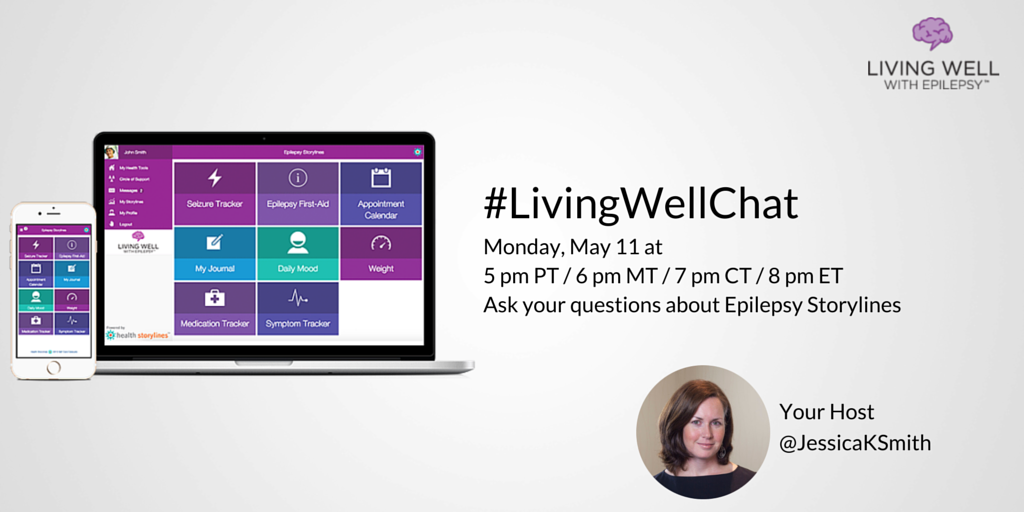
What is #livingwellchat?
#LivingWellChat is a conversation that takes place quarterly on Monday evenings starting at 8pm ET, on Twitter. Each chat covers a topic relevant to those of us living with epilepsy.
What will this next chat be about?
We will be chatting with the team from Self Care Catalysts who developed Living Well With Epilepsy’s app, Epilepsy Storylines. If you are using the app or are considering using Epilepsy Storylines, this is a great chance to chat with others who are currently using it.
What is Epilepsy Storylines?
The Epilepsy Storylines self-care tool from Living Well with Epilepsy™, and powered by Health Storylines™, lets you use the power of your story to personalize your care and create your own support network. Epilepsy Storylines allows you to track your seizures, mood, symptoms, and more, on the same timeline as your treatment. It gives you an accurate, shareable record of your experience between physician visits, and helps you and your care team collaborate on treatment strategies. The app is useful for someone living with epilepsy as well as a caregiver to someone living with epilepsy.
What is the hashtag?
The hashtag for the twitter chat is #livingwellchat
How can I participate?
1. Go to http://twubs.com/
How does the chat work?
On Twitter there are tons of conversations going on all at once. But when you add a hashtag like #livingwellchat to your tweets, then it becomes much easier for everyone in the conversation to follow along. Without that #livingwellchat hashtag included in your tweets, then we will miss out on your great contributions to the discussion.
The format of #livingwellchat is very simple: We start with a general topic, and the conversation flows from there. Lots of Twitter chats have a formal structure, only allowing a few minutes per question, but #livingwellchat is a bit more open. We encourage spontaneous discussion with tons of Q&A.
Can anyone join in the conversation?
Yep, please join in the chat. If you have been living with epilepsy for decades, if you are newly diagnosed, or if you are caring for a loved one who is living with epilepsy you will find something of interest on the next #LivingWellChat.
What if there are other topics I want you to cover?
You can suggest a topic for a future #livingwellchat on Monday’s chat or in the comments below. If you have an idea in mind, please let us know.
Any other ways I can follow along?
Or you can follow #livingwellchat right here:










Leave a Reply